The real reason wedding dresses are white
Did you know that brides didn’t always wear white? That the white wedding dress, as we know it today, didn’t really become a cultural ideal until the 19th century? And that it was one queen, one very public wedding, and one struggling industry that unintentionally (or maybe intentionally, who knows!) helped turn a fashion choice into a tradition?
I’m at the stage in life where wedding talks are all around. Every weekend there is a friend who is getting engaged, a cousin who is getting married, or someone is sending a photo of a ring into the group chat. Love and weddings are in the air (quite literally)!
That got me thinking about the different wedding customs and traditions followed around the world - the Polterabend in Germany, where porcelain is smashed before the wedding; the Greek tradition in which the best man ceremonially shaves the groom; the lasso ceremony in Mexican Catholic weddings, where a cord is placed around the couple; the joota chupai tradition in some North Indian weddings, where the bride’s side steals the groom's shoes and demands money for their return.
The specifics keep changing from place to place; the drama, apparently, does not.
No matter the culture, tradition, custom, or country, there is one thing that tends to receive an extraordinary amount of attention: what the bride wears.
Depending on the culture and ceremony, that might mean a lehenga or saree in India, a qipao in China, a kimono in Japan, a hanbok in Korea, an áo dài in Vietnam, a Moroccan kaftan or takchita, or any number of regional and family traditions.
On the other hand, there is the image that dominates much of Western bridal culture: the white gown.
That contrast between so many colourful bridal traditions around the world and the iconic Western white gown made me wonder something embarrassingly simple: why white?
Naturally, I went down the rabbit hole.
And somewhere between nineteenth-century fashion magazines, royal weddings, and British lacemakers, I discovered that white wasn’t always the rule. It’s newer than you think, and it wasn't about purity at all!
We built an entire industry around it. An entire aisle-walk, veil-lift, "you may now kiss the bride" mythology around one color. But here's the strange part: white wasn’t always the bridal default.
Before the 19th century, white was far from the default for Western brides. White gowns existed, but they were expensive, difficult to maintain, and wildly impractical for a dress most women hoped to wear again.
Brides wore whatever they had. Their best dress, regardless of shade. Blue, for faithfulness. Red, for luck. Black, for practicality, because a dark dress could survive a lifetime of Sundays after the wedding was over. White was expensive to keep clean and impossible to wear twice. It was not romantic. It was impractical.
So how did it become the whole point?
One woman. One wedding. One very good publicist, except the publicist was the entire British press.
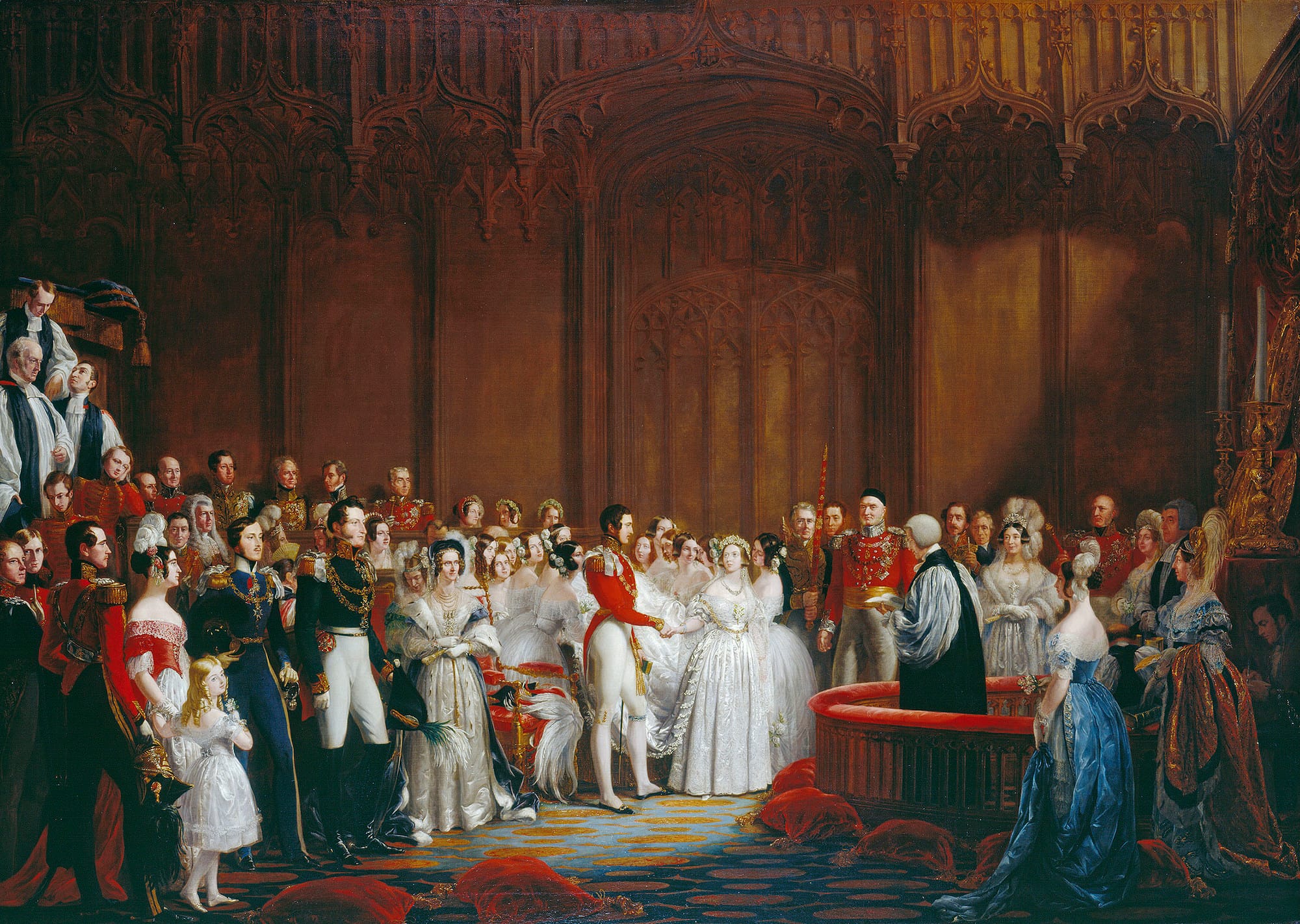
On 10th February, 1840, Queen Victoria married Prince Albert, and instead of the ermine robes, heavy embroidery, jewels, and the crimson velvet associated with state ceremony and what a monarch was supposed to wear, Queen Victoria chose something different.
She wore a white satin gown trimmed with handmade Honiton lace, orange blossoms in her hair, and a veil instead of a crown.
It was not a statement about virtue. It was a statement about lace.
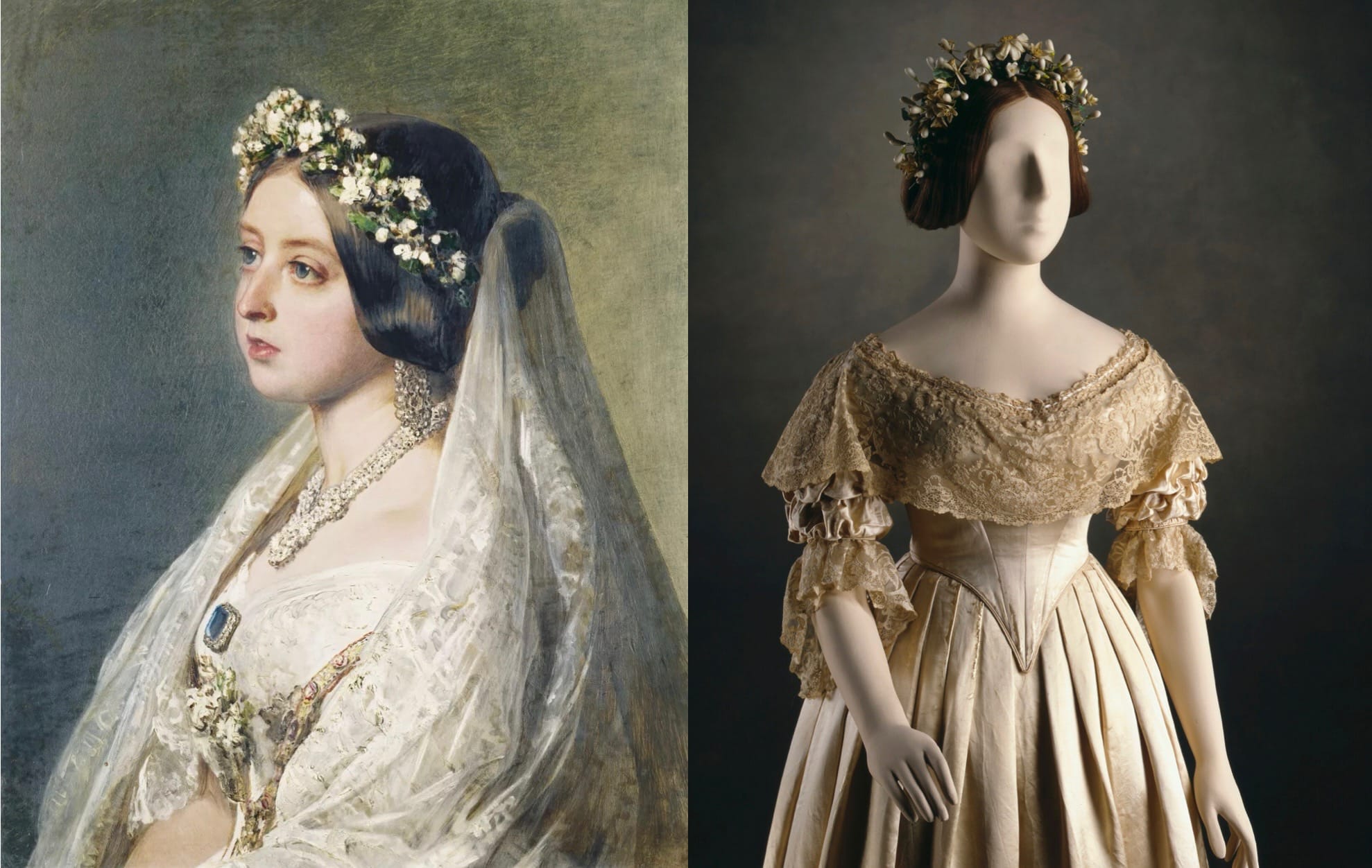
Britain's lace industry was struggling. Machine-made textiles were threatening traditional hand-work, and skilled artisans were under increasing pressure.
Victoria deliberately commissioned Honiton lace from Devon for her wedding dress, drawing attention to British craftsmanship at a moment when the industry needed it. The white satin simply provided the perfect backdrop for the intricate handmade lace. Even the silk used for the gown came from Spitalfields in London.
So one of the most recognisable symbols of modern romance was, at least partly, an act of nineteenth-century economic patriotism.
But nobody told the newspapers that.
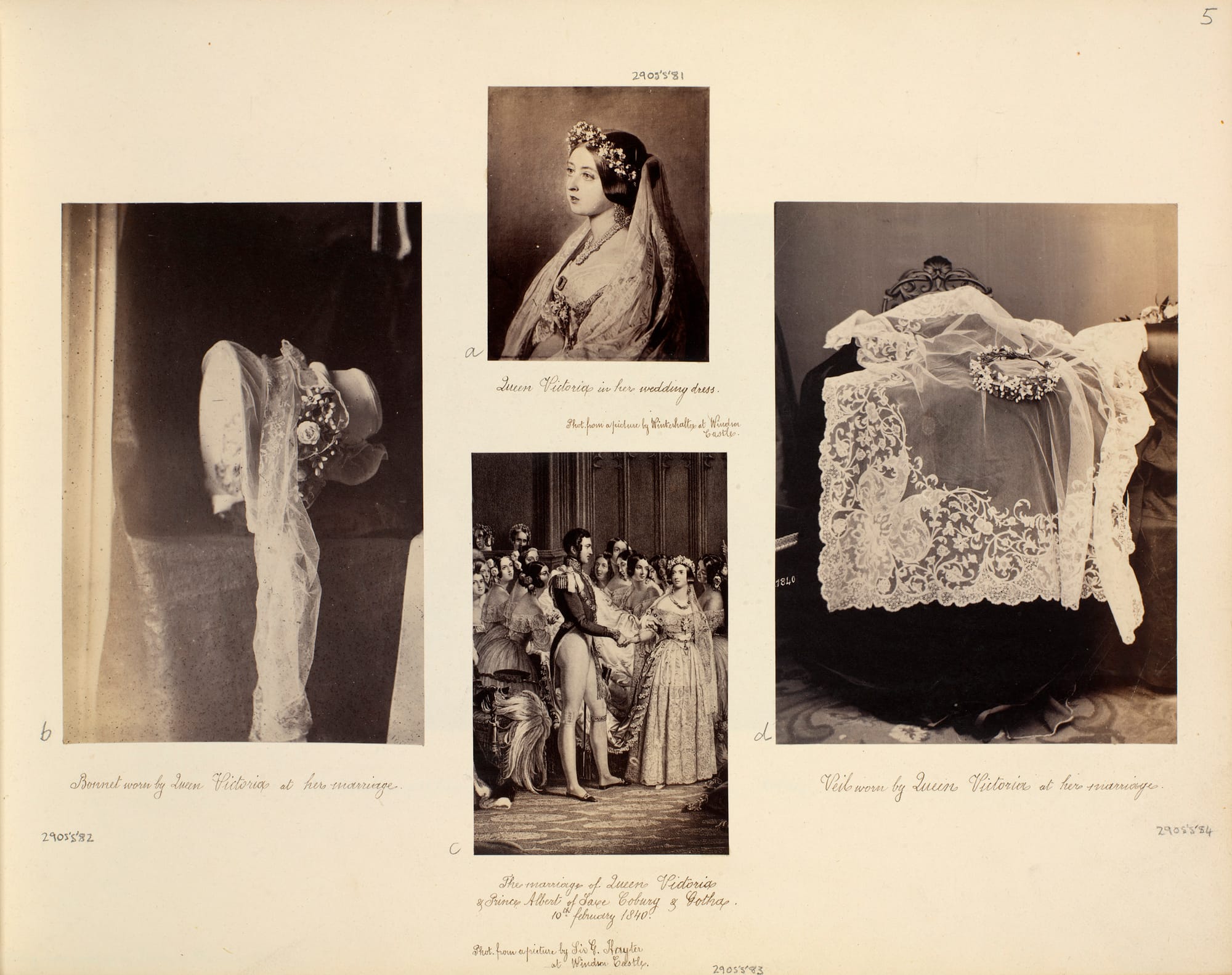
Victoria and Albert’s wedding was the most publicized event of its time, and every paper described the dress in loving, breathless detail. Fashion magazines picked it up next. The image of the young queen dressed in white lace and orange blossom was widely circulated. By 1849, Godey’s Lady’s Book, one of the most influential women’s magazines in America at the time, was describing white as “the most fitting hue” for a bride, tying it to purity and innocence.
It was a lovely sentence, but it was also completely invented. What I find fascinating is how confidently it was written.
Stories indeed have a strange way of making things feel inevitable.
Queen Victoria’s choice of white had nothing to do with virginity or purity. Those meanings became attached to the white bridal gown later, as fashion writers, magazines, and generations of brides repeated the association. What began as a thoughtful choice slowly acquired a different story, and eventually that story began to feel like tradition.
And the story worked so well that a hundred and fifty years later, we still believe that white was always what brides were meant to wear.
Maybe this is why I find traditions so fascinating in the first place.
From the outside, they can feel ancient and sacred. We inherit them already wrapped in meaning, rarely stopping to wonder who first decided and why we keep doing it. We do this constantly. We take a coincidence and call it fate. We take a habit and call it heritage.
I certainly never looked at a white wedding dress and thought of nineteenth-century lacemakers in Devon. I thought of weddings. And perhaps that is what time does to things. The practical reasons disappear, the accidents are forgotten, and what remains is the story we have chosen to carry forward.
Not every tradition has some ancient, profound meaning buried underneath it. Sometimes the opposite is true. Sometimes you keep digging, expecting to find an ancient ritual, and instead you find fashion, practicality, economics, love, imitation - all the very ordinary things people have always been made of.
Maybe that is what I love about looking at culture this way. You start with something as familiar as a wedding dress, pull gently at one loose thread, and suddenly an entire little history begins to unravel in your hands.
The next time I see a bride walking down the aisle in white, I know I’ll still think she looks beautiful.
I’ll just also be thinking about the lace.